Petőfi’s Canaan, 2022


Title: Petőfi’s Canaan / Petőfi Kánaánja
HD digital video with self-composed sound, digital graphics, pixel art, glitch techniques – 1280 × 720 px, duration: 3’22”
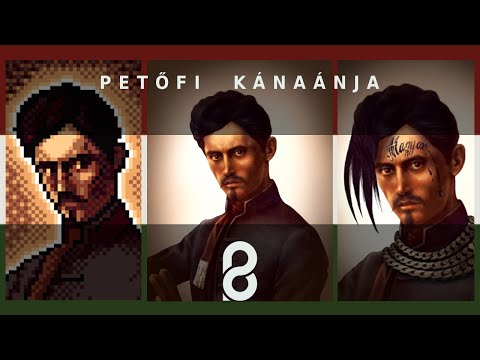
Petőfi’s Canaan is an audiovisual work that reinterprets one of the most iconic programmatic poems of 19th-century Hungarian literature – The Poets of the Nineteenth Century – through the lens of contemporary visual and sonic languages. At once homage and deconstruction, the piece synthesizes the political-poetic ethos of Sándor Petőfi with the urban visuality of the 21st century, drawing on hip-hop culture and the expressive affordances of digital technology. Created by Bónyai Barbara (Barbo Inject Q), the work engages in a canon-shifting intervention where Petőfi is not merely evoked as a historical figure, but reimagined as a living, transformed meme – a dark rapper, a glitch-entity, a post-iconographic construct.
At the core of the video lies a digitally reconstituted portrait of Petőfi, developed from the well-known daguerreotype, 19th-century paintings, and period descriptions. This image is visually and symbolically overwritten: through the aesthetic language of hip-hop – including chains, tattoos, teardrops – the figure of the national poet is recontextualized as a voice of the people and a moral leader. The video’s visual strata are layered with pixel art animation, noise-based glitch effects, and low-resolution textures, evoking a sense of medial dystopia and referencing the deferred arrival of a collective Canaan. In the sound composition, Petőfi’s poem is transformed structurally and thematically into rap form, with the fifth stanza recurring as a refrain – asserting the enduring urgency of the struggle for social justice.
Petőfi’s Canaan does not aim to illustrate the poem, but rather to rewrite it. The work resists aesthetic servitude and instead seeks a conceptual extension of the original text. This transmedial gesture not only contemporizes Petőfi’s artistic radicalism but also offers a reflection on the role of the artist within the post-media, late-capitalist public sphere. The piece emerges simultaneously as historical reconstruction, identity-political statement, and visual manifesto.
 Click to watch the audiovisual work in full